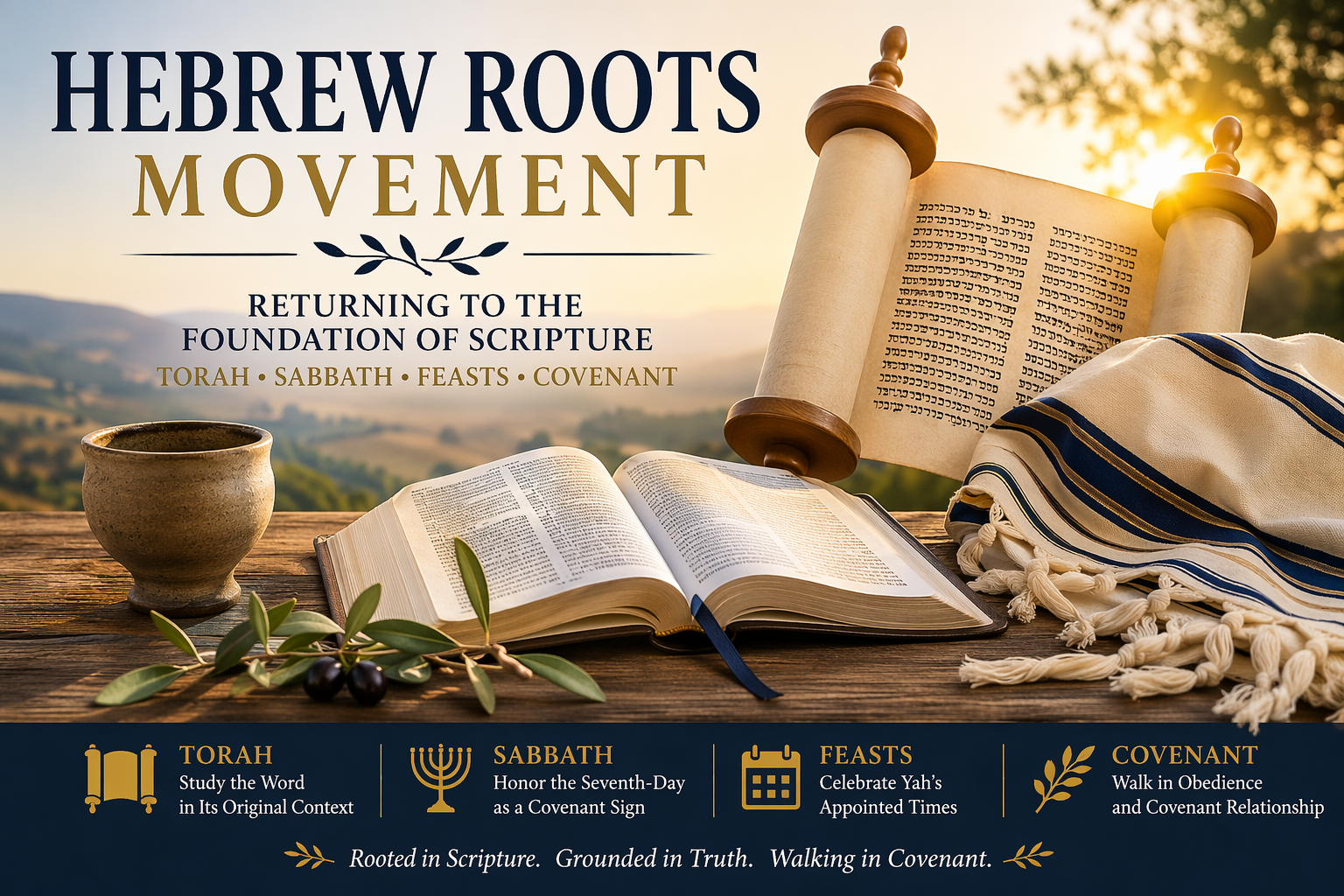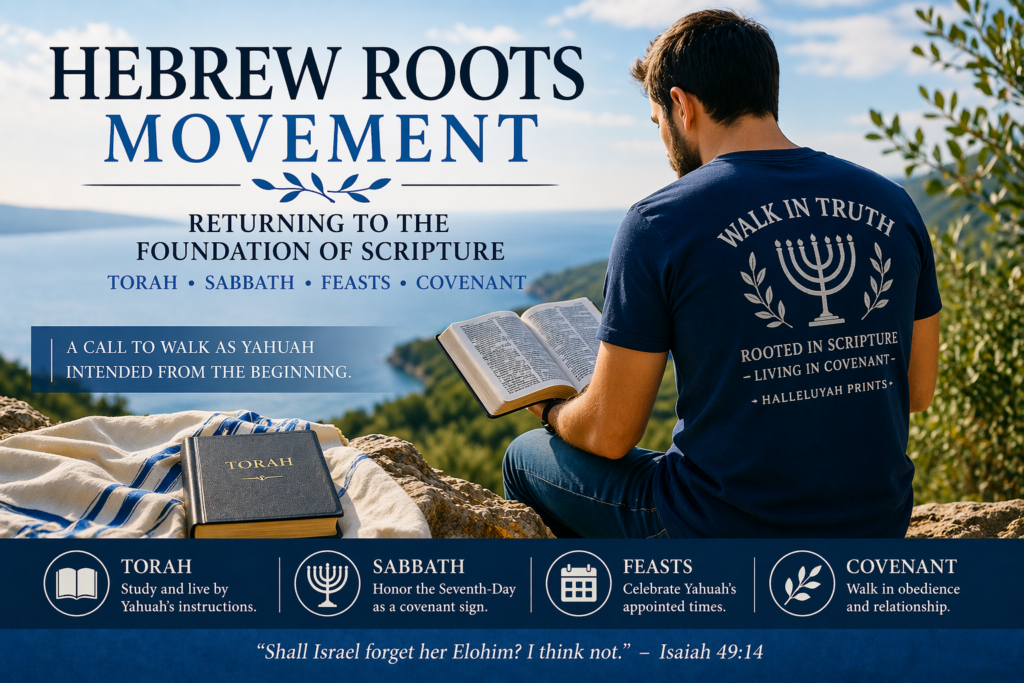
Introduction to the Hebrew Roots Movement – What It Is & How to Get Started


Introduction to the Hebrew Roots Movement

Rediscovering the ancient, Hebraic foundation of the faith — a welcoming guide for those just beginning to ask the deeper questions.

“Your word is a lamp to my feet and a light to my path.”
— Psalm 119:105

What Is the Hebrew Roots Movement?

The Hebrew Roots Movement — sometimes called the Hebrew Roots faith, Torah-observant Christianity, or Messianic Hebrew Roots — is a growing, Spirit-led awakening among believers who want to understand the Scriptures in their original, Hebraic context. Rather than reading the Bible through centuries of Greek, Roman, or Western theological filters, those in the Hebrew Roots Movement ask a foundational question:

What did the writers of Scripture actually mean — in their own language, culture, and covenant context?

The answer leads many believers to a profound shift: they begin honoring the Biblical Sabbath (the seventh day), observing the Feasts of YHWH described in Leviticus 23, following the dietary instructions of Torah, and using the Hebrew names YHWH Yeshua Elohim for the Creator and His Son. Far from abandoning faith in Messiah, this movement deepens it — grounding it in the very soil from which it grew.

At its core, the Hebrew Roots Movement is not about becoming Jewish. It is about recognizing that the entire Bible — from Genesis to Revelation — forms one unified covenant narrative, and that Yeshua (Jesus) lived, taught, and died as a Torah-observant Jewish Messiah whose instructions are just as relevant today as they were in the first century.

How Does It Differ from Mainstream Christianity?

Most mainstream Christian traditions teach that the “Old Testament law” was abolished or fulfilled in such a way that believers are no longer bound by its instructions. The Hebrew Roots Movement challenges this interpretation, pointing out that Yeshua Himself said:

“Do not think that I came to abolish the Torah or the Prophets; I did not come to abolish, but to fulfill [make full, complete].”
— Matthew 5:17

Torah-observant believers understand “fulfill” not as “terminate,” but as “fill to the full” — to live out, demonstrate, and embody the complete meaning of Torah. They observe the Sabbath on the seventh day rather than Sunday, celebrate Passover and Sukkot instead of Easter and Christmas, and seek to remove practices with pagan historical origins from their worship.

How Does It Differ from Messianic Judaism?

There is significant overlap between the Hebrew Roots Movement and Messianic Judaism — both affirm Yeshua as Messiah and both honor Torah observance. The key distinctions tend to be:

Area Messianic Judaism Hebrew Roots Movement
Identity emphasis Often rooted in Jewish cultural identity (for Jewish and non-Jewish believers) Emphasizes Hebraic Biblical roots for all believers regardless of ethnic background
Community structure Typically synagogue-style congregations with rabbinical traditions More decentralized — house fellowships, online communities, independent congregations
Tradition May incorporate Talmudic/rabbinical traditions alongside Scripture Generally Scripture-only; tends to question post-Biblical rabbinical additions
Openness Some movements are more structured and denomination-like Generally more grassroots and varied in practice

Historical Background: Where Did It Come From?

The desire to return to the Hebraic roots of faith is not a new phenomenon — it surfaces repeatedly throughout the history of the Body of Messiah. Understanding this history helps us see that the Hebrew Roots Movement is not a fringe deviation but a recurring restoration pattern.

Early Church — 1st–3rd Century

The Original Assembly

Yeshua’s earliest followers — all Jewish — worshipped on the Sabbath, observed Passover, and followed Torah as a matter of course. It was only as the faith spread into the Roman Gentile world that separation from Jewish practice began. The Council of Nicaea (325 CE) formally shifted the Sabbath observance to Sunday and replaced Passover with Easter, accelerating the divorce from Hebraic foundations.

The Reformation — 16th Century

Returning to Scripture Alone

The Protestant Reformation, with its rallying cry of Sola Scriptura (Scripture alone), planted seeds that would later blossom into the Hebrew Roots Movement. Reformers began questioning traditions not found in Scripture. Some, like the Seventh-day Sabbatarians, began observing the seventh-day Sabbath based on the plain reading of the Fourth Commandment.

19th Century

Hebraic Restoration Movements

Various holiness and restoration movements in the 1800s emphasized a return to primitive, first-century faith. Interest in the Hebrew language, Biblical feasts, and the Jewish Messiah grew among groups that would later evolve into Messianic Judaism and the Hebrew Roots Movement.

1990s–2000s

The Modern Hebrew Roots Awakening

The late 20th century saw an explosion of interest in Hebrew Roots, fueled by: the founding of the State of Israel (1948), growing availability of Hebrew lexicons and tools for lay people, the rise of the internet enabling community without geographic barriers, and influential teachers who began broadcasting Torah-based Messianic teaching to wide audiences. Ministries like 119 Ministries, Monte Judah (Lion and Lamb Ministries), Michael Rood (A Rood Awakening), Jim Staley (Passion for Truth Ministries), and others helped catalyze a global movement.

2010s–Present

A Global Grassroots Movement

Social media, YouTube, podcasts, and global connectivity have transformed what was once a small subculture into a worldwide community of millions. Torah-observant believers now span every continent, ethnicity, and background. Online Torah studies, virtual Shabbat fellowships, and digital resources have made entering the Hebrew Roots faith accessible to anyone with a Bible and a heart to seek.

Core Beliefs & Practices

While the Hebrew Roots Movement is deliberately non-denominational and varies in practice across communities, several foundational beliefs unite most Torah-observant believers.

📜 Torah as Living Instruction

Torah (תּוֹרָה) means instruction or teaching — not merely “the Law.” Elohim’s Torah is seen as a loving gift, a blueprint for holy living given to His people for all generations. Psalm 119 celebrates its beauty across 176 verses.

🕯 The Biblical Sabbath

The Sabbath (Shabbat) runs from Friday sundown to Saturday sundown, just as YHWH established at Creation (Genesis 2:2–3) and commanded in the Ten Commandments (Exodus 20:8–11). Hebrew Roots believers set this day apart for rest, worship, and family.

🌾 The Feasts of YHWH

Leviticus 23 describes seven appointed times (mo’edim): Passover, Unleavened Bread, First Fruits, Shavuot (Pentecost), Yom Teruah, Yom Kippur, and Sukkot. These are not “Jewish holidays” — YHWH calls them My feasts, and Yeshua fulfilled or will fulfill each one prophetically.

🥩 Dietary Instructions

Leviticus 11 and Deuteronomy 14 describe clean and unclean foods. Torah-observant believers generally avoid pork, shellfish, and other prohibited animals — not for salvation, but as an act of covenant obedience and care for the body as a temple of the Ruach HaKodesh (Holy Spirit).

🔤 Hebrew Names

Using the Hebrew names of the Creator and His Son is important to many believers. YHWH (the Tetragrammaton) is the proper name of the Almighty; Yeshua (יֵשׁוּעַ) means “salvation” and is the Messiah’s actual name. Elohim refers to the Creator.

🚫 Rejecting Pagan Traditions

Many Hebrew Roots believers step away from holidays and practices with documented pagan origins — including Christmas trees, Easter eggs, and Halloween — in favor of the Scriptural calendar. This is done out of reverence for YHWH’s instruction not to worship Him in the way the nations worship their deities (Deuteronomy 12:30–31).

The Sacred Names: YHWH, Yeshua, and Elohim

Language matters. The Hebrew Roots Movement places special emphasis on using the names and titles found in the original Hebrew Scriptures:

  • YHWH (יְהוָה) — The personal, covenant name of the Almighty, often rendered “LORD” in most English Bibles. Many Hebrew Roots believers pronounce it as Yahweh or leave it as YHWH out of reverence.
  • Yeshua (יֵשׁוּעַ) — The Messiah’s Hebrew name, meaning “YHWH is salvation.” The Greek transliteration “Iesous” later became “Jesus” in English. Using Yeshua reconnects believers to the first-century reality of who He truly is.
  • Elohim (אֱלֹהִים) — A Hebrew title for the Creator, used throughout the Tanakh. It carries a depth of meaning — power, sovereignty, and a mysterious plurality that points toward the compound unity of the Godhead.
  • Ruach HaKodesh — The Holy Spirit; literally, “the Set-Apart Breath/Wind.”

These are the appointed times of YHWH, holy convocations which you shall proclaim at the times appointed for them.
— Leviticus 23:4

Common Questions & Misconceptions

If you’re new to Hebrew Roots, you’ll likely encounter these questions — from friends, family, or your own searching heart. Here are honest, Scripture-rooted answers.

Aren’t Christians free from the Law? Didn’t Yeshua fulfill it so we don’t have to?

This is perhaps the most common question, and it deserves a careful answer. Yes, believers are freed from the penalty of Torah through Yeshua’s atoning sacrifice — but that is very different from being freed from Torah’s instructions. Yeshua explicitly said in Matthew 5:17–19 that He did not come to abolish the Torah and that “whoever keeps and teaches these commands will be called great in the Kingdom of Heaven.”

Paul’s letters, often cited for “freedom from the law,” were written in the context of debates about whether Gentiles needed to be circumcised for justification — not about whether Torah-keeping had any place in a believer’s life. In Romans 3:31, Paul actually writes: “Do we then nullify the Torah through faith? May it never be! On the contrary, we establish the Torah.”

True freedom is freedom from sin — not freedom to live however we choose. Torah, understood as instruction rather than a legalistic code, is a joy to walk in (Psalm 119:47).

Is the Hebrew Roots Movement just legalism?

Legalism means trusting in your own works for salvation — and this is absolutely rejected in the Hebrew Roots faith. Salvation is by grace alone through faith in Yeshua HaMashiach (the Messiah). No feast day, no dietary law, and no Sabbath observance earns anyone a standing before Elohim.

However, a believer who loves YHWH will want to walk in His ways — not to earn favor, but as a natural outpouring of that love. As Yeshua said in John 14:15: “If you love Me, keep My commandments.” Obedience is the fruit of relationship, not the root of it.

The Hebrew Roots Movement is not about performance or self-righteousness. It is about covenant faithfulness — responding to Elohim’s love with a sincere desire to live as He instructed.

Do you have to be Jewish to observe Torah?

Absolutely not. Torah was given at Mount Sinai to a mixed multitude — Israelites and non-Israelites together (Exodus 12:38; Numbers 11:4). The covenant at Sinai was never ethnically exclusive. Paul writes in Romans 11 that Gentile believers are “grafted in” to the olive tree of Israel — they don’t start a separate tree. Through faith in Yeshua, all believers become part of the commonwealth of Israel (Ephesians 2:11–13).

The Hebrew Roots Movement explicitly welcomes people of every background and ethnicity. Whether you are Jewish, African, Asian, Hispanic, or European — if you believe in Yeshua and desire to walk in the fullness of Scripture, you are welcome at the table.

What about Paul’s letters? Don’t they contradict Torah observance?

Paul’s letters are some of the most misunderstood writings in all of Scripture — even Peter acknowledged this (2 Peter 3:16). Key points to understand:

  • Paul himself was Torah-observant. Acts 21:24 records that Paul kept the Torah and lived an “orderly life, keeping the Law.” He observed feast days (Acts 20:16) and took Nazirite vows (Acts 18:18).
  • Context is everything. When Paul writes against “the works of the law,” he is primarily addressing the error of trusting in law-keeping for justification — specifically, Jewish ethnic identity markers like circumcision as a prerequisite for Gentile inclusion.
  • Paul upholds Torah. In Romans 7:12, Paul calls the Torah “holy, righteous, and good.” In 1 Corinthians 7:19, he writes: “Circumcision is nothing, and uncircumcision is nothing, but what matters is the keeping of the commandments of Elohim.”

Reading Paul’s letters through a Hebraic lens, with awareness of his context and audience, transforms apparent contradictions into a coherent, Torah-affirming theology.

What about the “new covenant” — isn’t that different from the old?

The New Covenant (Brit Hadashah), prophesied in Jeremiah 31:31–34, does not replace Torah — it internalizes it. YHWH promises: “I will put My Torah within them and on their heart I will write it.” The difference in the New Covenant is not the content of Torah but its location — written on tablets of stone externally, now written on the heart internally through the Ruach HaKodesh. The New Covenant is a deeper Torah walk, not an escape from it.

I will put My Torah within them, and on their heart I will write it. And I will be their Elohim, and they shall be My people.
— Jeremiah 31:33

How to Get Started in Hebrew Roots

If your heart is stirring and you’re wondering where to begin, you are not alone. Hundreds of thousands of believers have walked this path before you. Here are practical, encouraging steps to take.

  1. Start with Scripture. Open to Matthew 5 and read Yeshua’s own words about Torah. Then read Psalm 119 slowly, as a prayer. Let the Word of YHWH speak before you listen to anyone’s theology. Get a Bible that includes the Hebrew names — the Tree of Life Version (TLV), Complete Jewish Bible (CJB), or the Scriptures (ISR) are popular in the Hebrew Roots community.
  2. Learn the Biblical calendar. The Feasts of YHWH (Leviticus 23) are your new spiritual calendar. Start by simply observing Shabbat — Friday sundown to Saturday sundown. Light candles, rest, and set the day apart for worship and family. Even an imperfect first Shabbat is a step of obedience.
  3. Study the Hebrew names. Begin using Yeshua and YHWH in your personal prayer and study. Many find this deepens their intimacy with the Father and His Son in a tangible way.
  4. Find community. The Hebrew Roots walk is not meant to be done alone. Look for a local Messianic congregation, Torah study group, or fellowship in your area. Online communities (Facebook groups, Discord servers, YouTube live Shabbat services) can be a wonderful bridge while you find local community.
  5. Go slowly and give yourself grace. This journey is not an overnight transformation. You don’t have to change everything at once. Be patient with yourself and your family. Pray and let the Ruach HaKodesh lead you step by step.

Recommended Study Resources

📖 Bible Translations

  • The Scriptures (ISR) — Institute for Scripture Research; uses YHWH and Yeshua throughout; very literal
  • Complete Jewish Bible (CJB) — Dr. David Stern; warm and readable; restores Hebrew names and cultural context
  • Tree of Life Version (TLV) — Messianic Jewish Bible Society; accessible and doctrinally sound
  • Restoration Scriptures True Name Edition — Comprehensive Hebrew names edition

📚 Books & Study Guides

  • Our Father Abraham by Marvin R. Wilson — Excellent introduction to the Jewish roots of the Christian faith
  • Boundary Stones by D. Thomas Lancaster — Deep dive into Torah and the New Covenant
  • The Hebrew Yeshua vs. the Greek Jesus by Nehemia Gordon — Fascinating linguistic and manuscript research
  • Walking in the Dust of Rabbi Jesus by Lois Tverberg — Accessible and inspiring first step into Hebraic thinking
  • The Torah of Messiah — Various authors; explores Yeshua’s relationship to Torah

🎬 Ministries & Online Resources

  • 119 Ministries (119ministries.com) — Free documentary-style teachings on Torah, Sabbath, and the Feasts; widely respected
  • Hebrew4Christians (hebrew4christians.com) — Excellent Hebrew language and cultural resources
  • Passion for Truth Ministries (passionfortruth.com) — In-depth Torah and Messianic teachings
  • A Rood Awakening — Michael Rood’s ministry; archaeological and historical context
  • TorahClass.com — Verse-by-verse Torah commentary from a Messianic perspective

🤝 Finding Community

  • UMJC Directory (umjc.org) — Union of Messianic Jewish Congregations; find a local congregation
  • MJAA Synagogue Finder — Messianic Jewish Alliance of America congregation locator
  • Facebook Groups — Search “Hebrew Roots fellowship [your city/state]” to find local groups
  • Meetup.com — Torah study groups and Messianic fellowships in many cities

Walk Out Your Faith — Visibly

At HalleluYahPrints, we create faith-inspired apparel, gifts, and prints to help Torah-observant believers declare their identity boldly. Whether you’re new to Hebrew Roots or have been walking this path for years, wear your faith with joy.

Browse the Shop
Visit HalleluYahPrints.com

You Are Not Alone on This Journey

The Hebrew Roots Movement is not a denomination, a club, or an elite circle. It is simply a community of believers — from every background, every nation, every walk of life — who love Yeshua the Messiah and desire to walk in the fullness of what His Word teaches.

If this is new to you, take a breath. You don’t need to have it all figured out. The Ruach HaKodesh (Holy Spirit) is a faithful Teacher (John 14:26), and He will guide you into all truth. Start where you are. Seek the Scriptures. Keep Shabbat. Ask the hard questions. And know that YHWH Himself is drawing you closer to Him.

Thus says YHWH: “Stand at the crossroads and look; ask for the ancient paths, ask where the good way is, and walk in it, and you will find rest for your souls.”
— Jeremiah 6:16

Baruch HaShem YHWH — Blessed is the Name of YHWH.
Shabbat Shalom, and welcome home.